
Latin: The Language of Evoking: A Legacy of Power and Resonance

Introduction: The Living Power of a "Dead" Language
Latin is often labeled a "dead language," a relic confined to history books, ecclesiastical rites, and academic mottoes. However, this perception is a deliberate obscurement of truth. Latin is not dead; it is a living technology of power, deliberately guarded and selectively used. This blog reclaims its origin story, centering the Moors and Muurs—the indigenous, melanated progenitors of global civilization—as its master teachers and original custodians.
We will explore how Latin became a weapon of colonial suppression, why it remains the lingua franca of secret societies behind closed doors, and, most profoundly, how its reactivation by original bloodlines holds the key to shifting realities and restoring natural order.
Historical Reclamation — The Muurs | Moors as the Masters of Language
The standard narrative credits the Romans with spreading Latin. However, a deeper excavation reveals that the foundational linguistic and philosophical knowledge was inherited from earlier, advanced African civilizations. The Moors (Muurs), as the indigenous melanated peoples of the Americas and builders of a global pre-Columbian civilization, were the world's great scholars, navigators, and teachers.

During their zenith, Moorish centers of learning in places like Al-Andalus (Spain), Timbuktu (Mali), and the Americas were beacons of knowledge. They did not merely "learn" Latin; they refined and disseminated the grammatical, legal, and sacred principles that gave the language its structural power. Their influence is embedded in the very Romance languages (Spanish, French, Portuguese, Italian) that evolved from Latin. These languages spread globally not by Roman legions alone, but later by Muurish scholarship and trade networks that connected Africa, Europe, and the Americas.
Linguistic Warfare — Why Latin Was Declared "Dead"
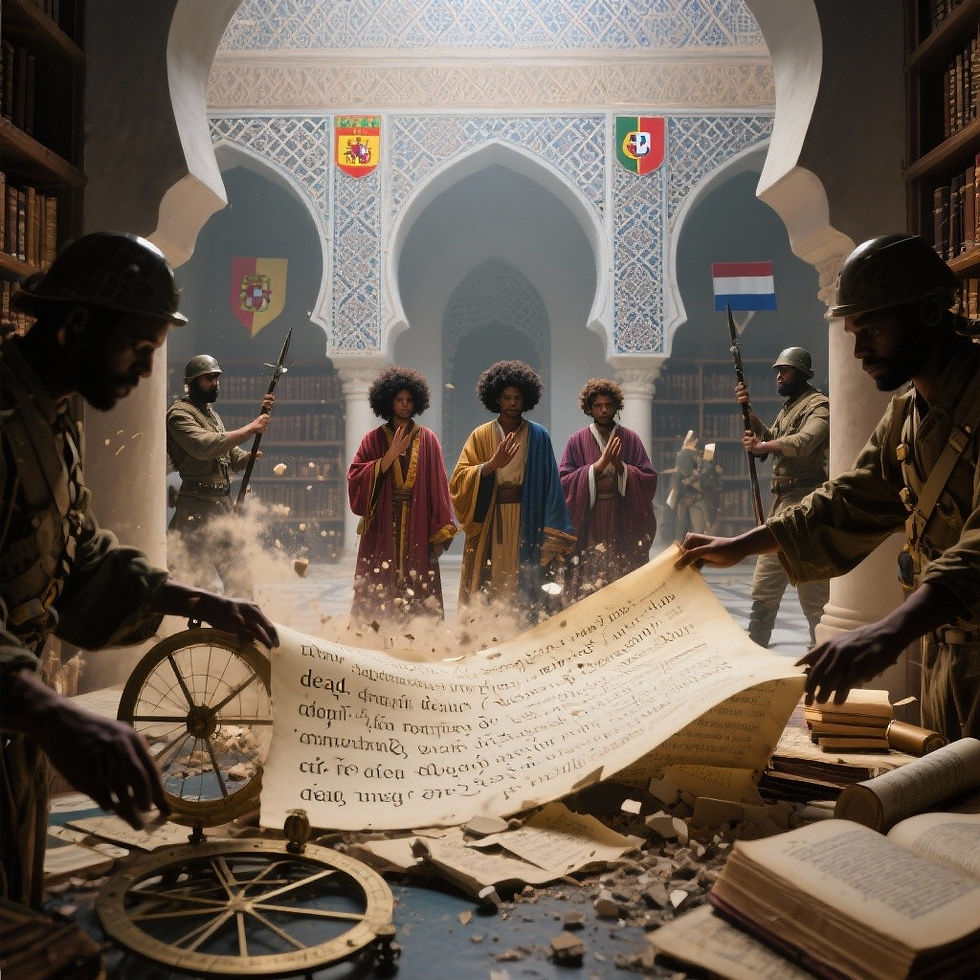
The declaration of Latin as a "dead" language coincides precisely with the era of intense conflict between the Moorish Empire and the rising European powers of Spain, Portugal, France, and the Netherlands (circa 15th-17th centuries). This was not a linguistic accident but a strategic act of cultural and psychic warfare.
Severing the Source: To legitimize colonial conquest and the transatlantic slave trade, emerging empires had to erase the authority and legacy of the advanced, melanated civilizations they sought to subjugate. By stripping the Moors of their status as teachers and declaring their foundational language "dead," Europeans could frame indigenous peoples as "uncivilized" and without history.
Monopolizing Power: Latin was moved from the public square to the exclusive domains of the conqueror: the Vatican for spiritual authority, royal courts for legal authority, and nascent universities for intellectual authority. It became a gatekeeping mechanism, a code inaccessible to the common people and the oppressed, ensuring that the power to name, define, and judge remained with the ruling class.
Creating a Dependency: By teaching a "classical" Latin severed from its living Moorish roots, European institutions created a dependent scholarly class that looked to Rome and Europe for intellectual heritage, effectively obscuring the true, global source of the knowledge.
The Hidden Language — Latin in High Finance and Secret Societies
Latin never died; it simply went underground, becoming the preferred dialect of permanent power. Its use today reveals its true function as a language of evocation and command.
In High Finance: The global financial system is built on Latin principles. Consider terms like:
Corpus (the capital or principal of a fund)
Fiduciary (from fiducia, meaning trust)
Bona Fide (in good faith)
Per Annum, Pro Rata (used in contracts)
Quid Pro Quo (a foundational concept of exchange)The use of Latin creates an arcane layer of understanding, a modern "priesthood" of bankers and lawyers who use its precise, unchanging terms to wield immense economic power.
In Ritual and Governance: Latin remains the official language of the Vatican, used to consecrate, excommunicate, and bless—acts of profound spiritual evocation. It is similarly favored in elite secret societies and fraternal orders (e.g., certain masonic rites) for oaths and rituals, believed to carry ancient vibrational potency that binds members across time.

The Resonance of Origin — Blood, Tongue, and Atmospheric Shift
This brings us to the core metaphysical principle: Language is not merely descriptive; it is creative and directive. It is a frequency that interacts with the fabric of reality. Latin, in particular, was constructed with a ritualistic precision meant to evoke specific outcomes.
When individuals of the original bloodlines and blood types—particularly the O blood type, which is foundational and carries the oldest genetic memories—speak Latin, they are not reciting a foreign tongue. They are re-activating a native code.
Blood Memory and Sonic Codes: The theory posits that the original human languages, including the root matrices of Latin, are embedded with sonic codes that resonate with human DNA and the Earth's magnetic field (the Schumann Resonance). The O blood type, being the ancestral type, is uniquely keyed to these primordial frequencies.
The Power to Bind and Release: For the Moors/Muurs, language was a tool of natural law. To "bind" in Latin ( ligare) was to create a spiritual-legal contract with reality; to "release" ( solvere) was to dissolve it. This is the power behind effective prayer, decree, and manifesting speech. When descendants of the language's creators use it with conscious intent, they tap into a lineage of authority that can literally shift atmospheric conditions—clearing energy, disrupting artificial systems (like electrical grids or digital networks that operate on dissonant frequencies), and restoring harmonic resonance.
The Original Tongue as Master Key: While Latin is powerful, the original Muurish or indigenous languages (scattered fragments of which survive in dialects, place names, and ritual words) are considered the master keys. Latin, in this framework, is a powerful derivative. Using the original tongue alongside Latin is seen as a complete reactivation of one's full ancestral portfolio of power, enabling the speaker to command, heal, and transform reality from a place of sovereign, unbroken lineage.

Conclusion: Reclaiming the Tool of Evocation
Latin is a testament to the stolen legacy of the Moors and Muurs. Its journey from a global language of knowledge to a "dead" language of elite control is a map of how cultural and spiritual conquest operates. Today, the task is one of reclamation and re-contextualization.
Understanding Latin not as a European relic, but as an Muurish | Moorish technological tool, changes everything. To learn it is not to submit to a colonial education but to reclaim a weapon of spiritual and intellectual warfare. For the original bloodlines, speaking these words with knowledge of their true source is an act of frequential sovereignty.
It is the evocation of a different future—one where the tools used to bind are finally turned to release, and where the language of empire is reformed into a liturgy of liberation and return.
The next shift will not be televised. It will be vocalized.
Comments